The Hidden Language of Perfume Notes (What Oud, Vanilla, and Musk Really Signal)
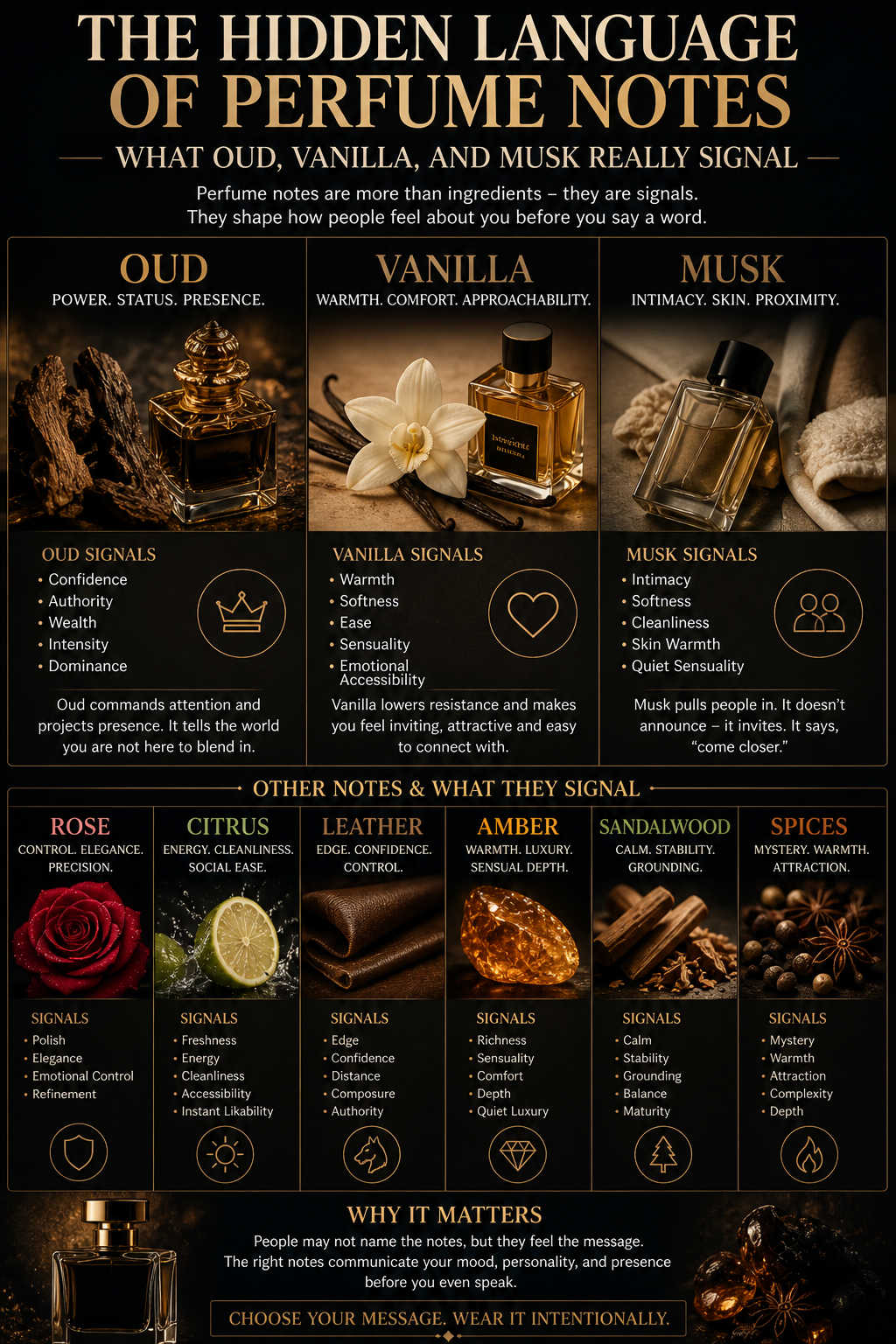
Most people think perfume notes are just ingredients.
They’re not.
In reality, perfume notes act more like social signals than simple scent components. They shape how people read you before you speak, before you move, and often before they consciously realize what they’re smelling.
That is the hidden language of fragrance.
People rarely identify oud, vanilla, or musk with technical precision.
What they do register—instantly—is what those notes feel like.
And that feeling becomes perception.
Perfume is not just about smell.
It is about what your scent quietly communicates.
1. Perfume Notes Are Emotional Shortcuts
When someone smells your fragrance, they are usually not analyzing:
- the composition
- the ingredient list
- the concentration
- the quality of raw materials
They are reacting emotionally and subconsciously.
The brain processes scent faster than logic.
Before someone can explain what they smell, they have already decided what it suggests.
That suggestion often registers as:
- warm or cold
- clean or heavy
- soft or intense
- inviting or distant
- safe or dominant
This is why perfume notes matter beyond smell.
They influence mood, perception, and social response.
2. Oud Signals Power, Wealth, and Authority
Oud is one of the most commanding notes in perfumery.
It is rich, dense, and difficult to ignore.
Even when refined, oud rarely reads as casual.
Oud often signals:
- authority
- confidence
- power
- wealth
- intensity
This is why oud-heavy fragrances often feel:
- luxurious
- dominant
- expensive
- assertive
Oud creates presence.
It tells people you are not trying to blend in.
That is why it is often associated with status and confidence.
But there is a downside: oud demands control.
Used well, it feels deliberate and powerful.
Used badly, it feels overwhelming, aggressive, and socially unaware.
Oud is not subtle.
That is both its strength and its risk.
3. Vanilla Signals Warmth, Comfort, and Attraction
Vanilla is one of the easiest notes for the brain to like.
It feels familiar, warm, and emotionally safe.
Vanilla often signals:
- comfort
- softness
- warmth
- sensuality
- emotional openness
This is why vanilla-heavy fragrances often feel:
- attractive
- easy to approach
- comforting
- inviting
Vanilla lowers resistance.
It makes a fragrance feel easy to like, which is why it often performs well socially and gets compliments quickly.
But vanilla also has limits.
Too much vanilla can signal:
- oversweetness
- predictability
- lack of sophistication
Used well, vanilla feels smooth and magnetic.
Used poorly, it feels obvious and repetitive.
Vanilla works because it is emotionally familiar.
Its strength is accessibility.
4. Musk Signals Intimacy, Skin, and Quiet Sensuality
Musk works differently from oud and vanilla.
It does not usually project loudly.
It stays closer. Softer. More personal.
Musk often signals:
- intimacy
- softness
- skin warmth
- cleanliness
- quiet sensuality
This is why musk-heavy fragrances often feel:
- intimate
- subtle
- clean
- personal
- addictive
Musk rarely demands attention.
Instead, it creates proximity.
It does not say:
“notice me.”
It says:
“come closer.”
That makes musk one of the most effective notes for close interaction, personal space, and understated attraction.
Musk is less about presence.
It is about pull.
5. Rose Signals Elegance, Control, and Refinement
Rose is one of the most misunderstood notes in perfumery.
Many people reduce it to “floral,” which misses the point entirely.
In modern fragrance, rose often signals:
- refinement
- elegance
- control
- composure
- emotional precision
Rose can feel:
- polished
- expensive
- romantic
- sophisticated
Rose is not automatically soft.
Depending on how it is built, rose can feel:
- elegant
- sharp
- regal
- emotionally controlled
Especially when paired with oud, woods, saffron, or spice, rose becomes less delicate and more authoritative.
Rose often signals discipline disguised as beauty.
6. Citrus Signals Freshness, Ease, and Social Intelligence
Citrus is immediate.
It is one of the fastest note families for the brain to process and accept.
Citrus often signals:
- cleanliness
- freshness
- ease
- energy
- accessibility
This makes citrus fragrances feel:
- effortless
- socially safe
- clean
- polished
- easy to like
Citrus works because it creates instant comfort.
It does not challenge people.
It reassures them.
That makes it ideal for:
- daytime
- warm weather
- offices
- professional settings
Citrus does not signal dominance.
It signals social ease.
7. Leather Signals Edge, Control, and Distance
Leather is sharper psychologically.
It often signals:
- confidence
- edge
- control
- distance
- authority
Leather-heavy fragrances often feel:
- serious
- composed
- structured
- self-contained
Leather creates tension.
It is less inviting than vanilla, less intimate than musk, and less easy than citrus.
That is exactly what gives it power.
Leather often signals emotional restraint and control.
8. Amber Signals Warmth, Depth, and Quiet Luxury
Amber is one of the smoothest ways to communicate richness.
It often signals:
- warmth
- depth
- sensuality
- comfort
- quiet luxury
Amber feels:
- smooth
- expensive
- warm
- calm
- refined
Amber rarely feels aggressive.
It feels controlled.
It communicates comfort with weight and elegance with softness.
Amber is less loud than oud, less sweet than vanilla, and often more refined than both.
9. Why This Matters in Real Life
Most people choose perfume based on:
- hype
- compliments
- price
- popularity
But those are weak filters.
The better question is:
What is this fragrance communicating before I speak?
Because scent creates assumptions.
People may not consciously identify the note.
But they will feel the message:
- warm
- powerful
- clean
- elegant
- sensual
- intense
That emotional reading shapes how they perceive you.
10. Wear Notes With Intention
The smartest fragrance users do not just ask:
“What smells good?”
They ask:
“What does this signal?”
That is the difference between wearing fragrance casually and wearing it strategically.
Because perfume notes communicate more than scent:
- Oud = power
- Vanilla = warmth
- Musk = intimacy
- Rose = refinement
- Citrus = ease
- Leather = control
- Amber = quiet luxury
Once you understand what notes signal, perfume becomes more than preference.
It becomes communication.
Final Truth
Perfume notes are not just ingredients.
They are emotional cues.
They shape how people read your presence before you say anything at all.
That is the hidden language of perfume.
And once you understand what notes are signaling…
You stop choosing fragrance based only on smell—and start choosing based on what it says.