How to Build a 5-Piece Perfume Wardrobe That Covers Every Scenario
A well-built fragrance wardrobe isn’t about quantity—it’s about coverage.
Each scent should serve a clear role, with minimal overlap.
If two perfumes do the same job, one of them is useless.
1. The Daily Signature (Your Identity Scent)
This is your default. The scent people associate with you.
What it should do:
- Work in most environments
- Be versatile across day and night
- Feel natural, not forced
- Match your personality baseline
Profile:
- Clean woody, musky, or soft spicy
- Balanced projection (not loud, not weak)
Mistake people make:
Choosing something trendy instead of something that actually fits them.
If this is wrong, your entire wardrobe collapses.
2. The Professional / Office Scent (Controlled & Respectful)
This is where discipline shows.
You’re not trying to impress—you’re trying to avoid offending while still smelling refined.
What it should do:
- Stay close to the skin
- Feel clean and polished
- Be safe in close environments
Profile:
- Fresh, citrus, soft florals, light woods
- Low projection, moderate longevity
Mistake people make:
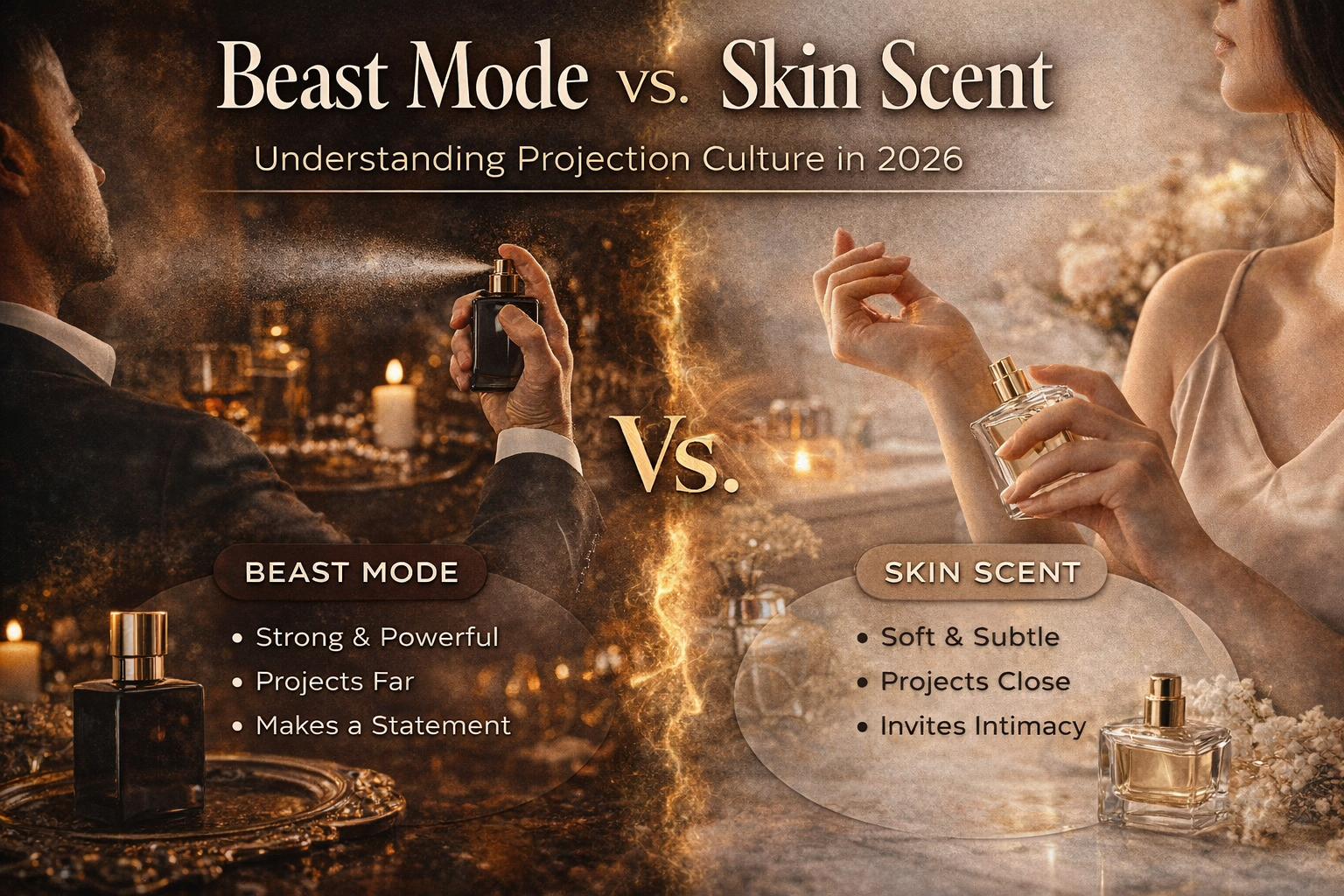
Wearing beast mode fragrances to work and thinking it signals confidence.
It doesn’t—it signals lack of awareness.
3. The Statement / Beast Mode (Presence & Power)
This is your weapon.
Not for daily use. Not for subtlety. This is for impact.
What it should do:
- Command attention
- Project strongly
- Leave a memorable trail
Profile:
- Oud, amber, vanilla, heavy spices
- High projection and longevity
Use cases:
- Events
- Nightlife
- Cold weather
- High-energy environments
Mistake people make:
Using this too often. If everything is loud, nothing is special.
4. The Intimate / Skin Scent (Close Encounters)
This is where most people are weak—they don’t understand subtlety.
This scent isn’t for the room. It’s for the person next to you.
What it should do:
- Stay soft and close
- Feel clean, warm, or slightly sensual
- Blend with your natural skin
Profile:
- Musks, soft florals, creamy woods
- Low projection, smooth dry-down
Use cases:
- Dates
- Close conversations
- Indoor settings
- Personal moments
Mistake people make:
Trying to impress with projection instead of creating intimacy.
5. The Seasonal Specialist (Climate Control)
Your environment matters more than your preference.
A fragrance that works in cold weather can become suffocating in heat.
What it should do:
- Adapt to climate
- Perform optimally in specific weather
Two directions:
Hot Weather Option:
- Citrus, aquatic, fresh green
- Light, airy, refreshing
Cold Weather Option:
- Warm, spicy, sweet, resinous
- Dense and enveloping
Mistake people make:
Ignoring climate and blaming the perfume for “poor performance.”
How to Avoid Overlap (Critical Rule)
This is where most collections fail.
If your wardrobe looks like:
- 3 sweet fragrances
- 2 oud fragrances
You don’t have a wardrobe—you have duplicates.
Each bottle must answer:
“What role does this play that nothing else does?”
If you can’t answer that, don’t buy it.
The Ideal Structure (Simple Breakdown)
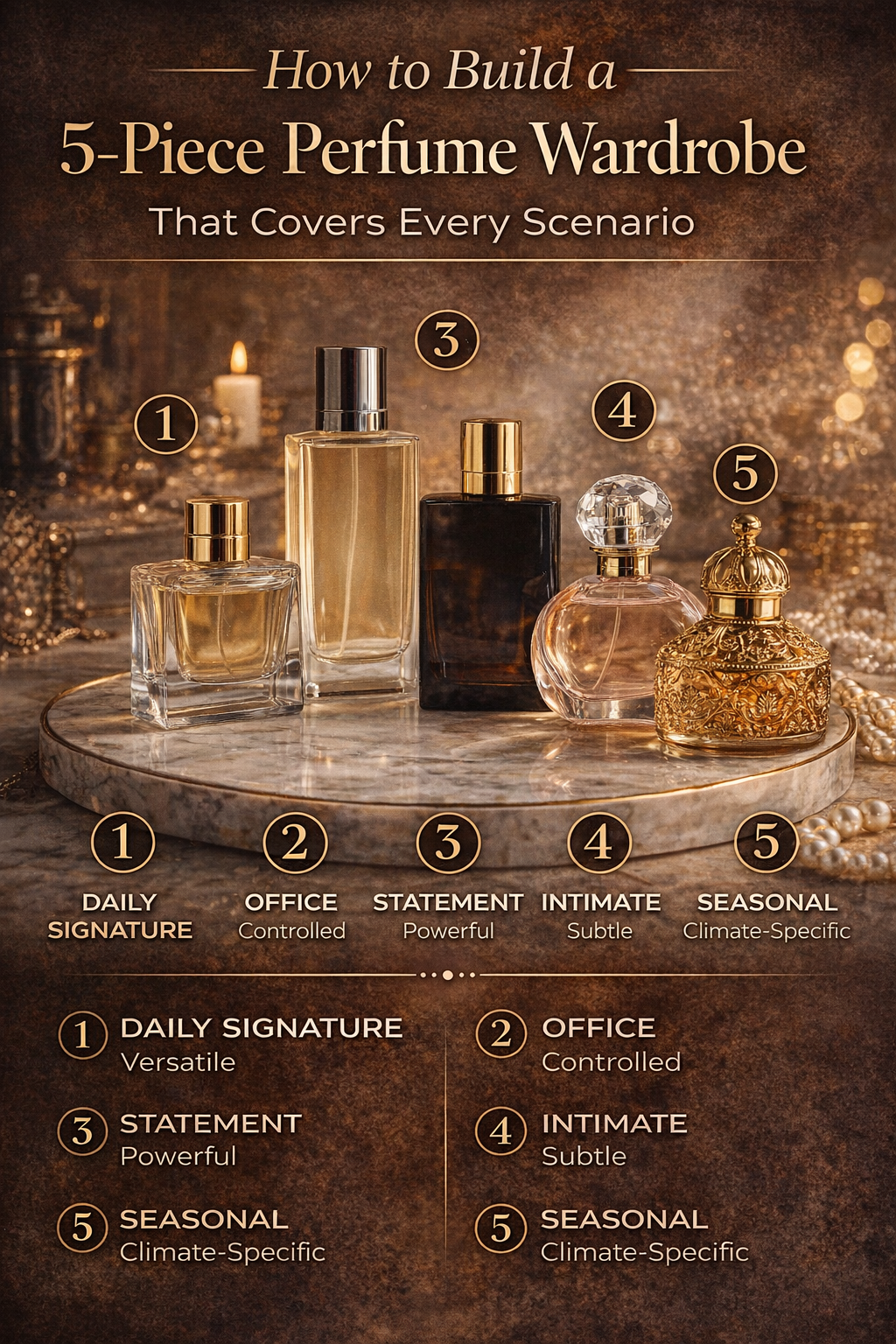
Your 5-piece wardrobe should look like this:
- Signature – Versatile, balanced
- Office – Clean, controlled
- Statement – Loud, powerful
- Intimate – Soft, close
- Seasonal – Climate-specific
That’s full coverage.
Anything beyond this is expansion—not necessity.
Upgrade Strategy (What Happens After 5?)
Once your base is solid:
- Upgrade quality, not quantity
- Replace weaker performers
- Add variations within your identity (not random scents)
You don’t go from 5 to 20 randomly.
You go from 5 to refined 7–10 with purpose.
Why This Matters
A structured wardrobe:
- Saves money
- Eliminates confusion
- Increases confidence
- Makes you more memorable
An unstructured collection does the opposite.
Final Reality Check
You don’t need more perfumes.
You need better selection discipline.
Because the difference between someone who “likes perfumes” and someone who understands fragrance is simple:
One collects bottles.
The other builds a system.