The Difference Between Luxury, Niche, and Overpriced
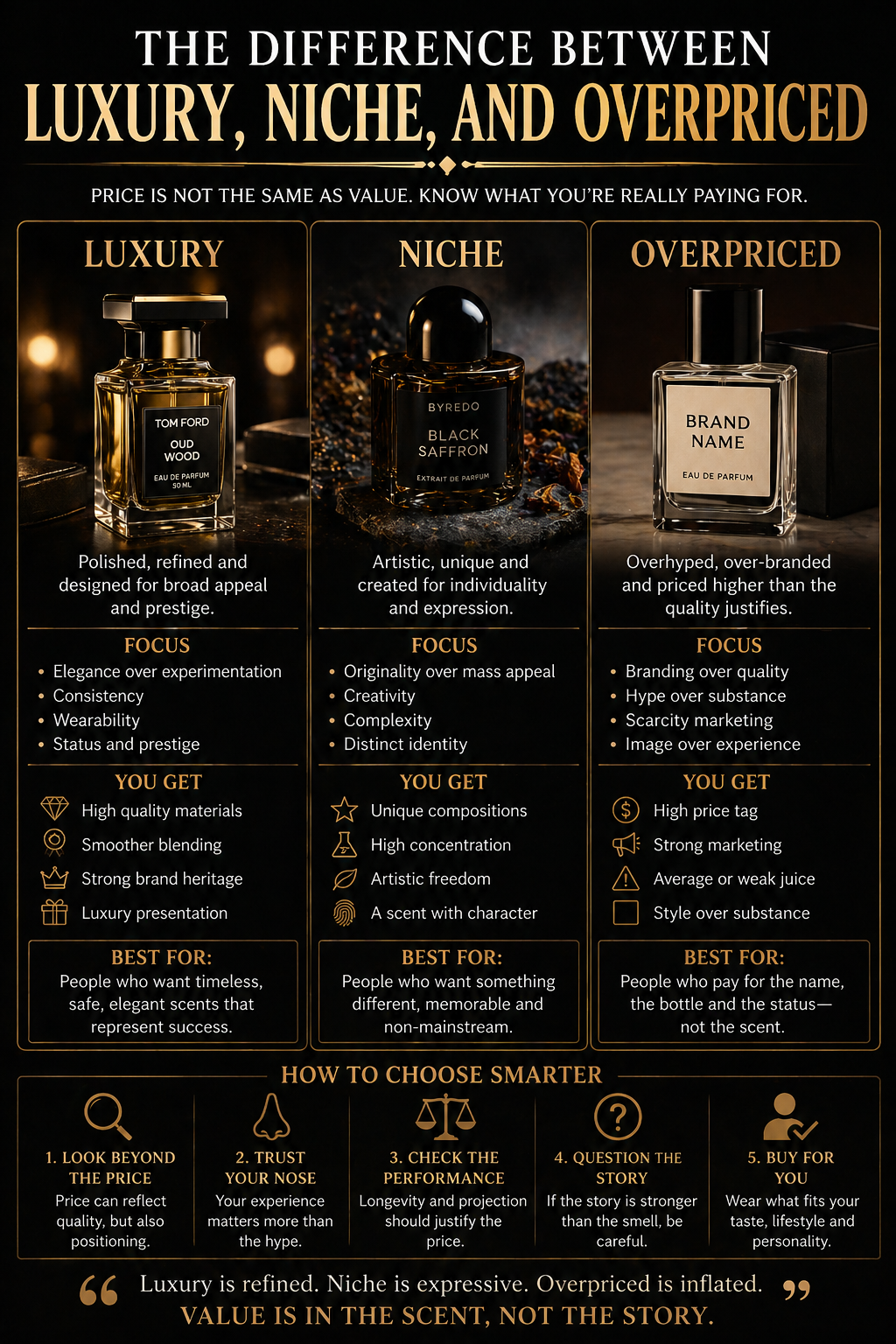
Most perfume buyers confuse price with quality.
That’s the mistake.
A high price does not automatically mean:
- better ingredients
- better performance
- better craftsmanship
- or better taste
It can mean those things.
It can also mean branding, hype, scarcity theater, and inflated positioning.
If you don’t understand the difference between luxury, niche, and overpriced, you will keep paying premium prices for average experiences.
1. What “Luxury” Actually Means in Perfume
Luxury is not just expensive packaging and a high price tag.
Real luxury in fragrance usually means:
- higher quality raw materials
- smoother blending
- better refinement
- stronger brand heritage
- elevated presentation
Luxury fragrances are designed to feel polished, aspirational, and easy to wear.
They are built for:
- broad appeal
- status signaling
- consistency
- prestige
That means luxury perfumes often prioritize:
- elegance over experimentation
- refinement over risk
- wearability over artistic shock
Luxury is not always the most original.
It is often the most socially acceptable version of “expensive taste.”
2. What “Niche” Actually Means
Niche does not mean “better.”
This is where people get fooled.
Niche means the brand is primarily focused on fragrance—not fashion, not cosmetics, not mass-market accessories.
That usually gives niche brands more freedom to:
- be creative
- be unconventional
- be polarizing
- take artistic risks
Niche perfumes often prioritize:
- originality
- concept
- complexity
- distinct identity
This can produce masterpieces.
It can also produce fragrances that are:
- strange
- difficult
- overly abstract
- impressive in theory, unpleasant in practice
Niche is not automatically superior.
It is simply less constrained.
3. What “Overpriced” Actually Means
Overpriced is simple:
The perfume costs more than the experience justifies.
That gap usually happens when:
- branding is stronger than composition
- packaging is better than performance
- hype is doing more work than the formula
- scarcity is manufactured, not earned
An overpriced fragrance often relies on:
- luxury storytelling
- exclusivity language
- social proof
- inflated prestige
And underneath it?
A very average scent.
This is where buyers confuse marketing value with olfactory value.
4. Luxury vs Niche: The Real Difference
The easiest way to understand it:
Luxury says:
“Make it elegant, polished, desirable, and easy to love.”
Niche says:
“Make it interesting, distinctive, and worth remembering.”
Luxury aims to impress broadly.
Niche aims to stand apart.
Luxury is often safer.
Niche is often riskier.
Luxury sells status.
Niche sells identity.
Neither is automatically better.
They serve different purposes.
5. Where Buyers Get It Wrong
Most buyers make one of three mistakes:
Mistake 1: Assuming expensive means superior
Price can reflect quality.
It can also reflect positioning.
Those are not the same thing.
Mistake 2: Assuming niche means refined
Some niche fragrances are brilliant.
Some smell like concept art in liquid form.
Original does not always mean wearable.
Mistake 3: Assuming compliments validate quality
A mass-appeal designer fragrance may get more compliments than a complex niche scent.
That does not make it better.
It makes it easier to like.
6. How to Tell If a Perfume Is Truly Luxury
A luxury fragrance usually earns its price through:
- refinement in blending
- polished transitions between notes
- better balance
- quality presentation
- consistency in wear
Luxury feels intentional.
Even when it is simple, it feels finished.
That is the difference between expensive and refined.
7. How to Tell If a Perfume Is Truly Niche
A niche fragrance usually earns attention through:
- originality
- artistic point of view
- recognizable brand DNA
- distinctive construction
Niche should feel like a perspective.
Not just a scent.
It should communicate something specific—not just smell expensive.
8. How to Spot Overpriced Fast
A fragrance is likely overpriced when:
- the story is stronger than the smell
- the bottle is more impressive than the blend
- the scent feels generic after the first 10 minutes
- the price is justified by exclusivity alone
- performance is average and composition is forgettable
If the marketing disappears and the fragrance becomes ordinary, it was overpriced.
9. What Actually Justifies Price
Price becomes easier to justify when a fragrance offers at least one of these clearly:
- exceptional raw materials
- strong performance
- distinctive identity
- artistic originality
- collector value
- refined craftsmanship
If it offers none of them, you are paying for positioning.
10. The Smart Buyer’s Framework
Before paying premium prices, ask:
- Am I paying for quality or branding?
- Is this refined, original, or just expensive?
- Does this smell distinctive enough to justify the price?
- Would I still want this if the bottle were plain?
- Is the experience worth the premium—or just the image?
That one question filters most overpriced fragrances immediately.
Final Truth
Luxury is refined.
Niche is expressive.
Overpriced is inflated.
The mistake is assuming all expensive perfumes belong in the first two categories.
They do not.
Some perfumes earn their price through craftsmanship.
Some earn it through originality.
Some are simply expensive because the market allows them to be.
Knowing the difference is what separates someone who buys perfume…
from someone who understands value.